Self-directed build · Interactive simulation
Two records that look identical until one of them isn't.
A non-clinical care coordinator works a post-discharge outreach queue. Two members surface the same number of concerning signals. Escalating is the right call for one and the wrong call for the other, and nothing in the interface says which is which.
About this piece. Decision Lab is a self-directed portfolio build, not a paid client engagement. The client, the member records, and every detail in the scenario below are fictional and illustrative. Every source cited in the evidence base was individually opened and verified before use — the survivors and the discard ledger both ship with it. The record-access model was confirmed with a health-plan subject-matter expert rather than assumed.
01 · The Problem
Nothing on the record was wrong.
"I read the whole record. Everything on it was normal. He was back in the hospital eleven days later."
— a care coordinator, describing the call she thinks about most
Every item on that record cleared its own threshold. No alert fired. The pattern only existed if someone put the pieces next to each other — which is a skill a checklist can't teach, because a checklist is a list of individual items and the entire problem is that individual items pass.
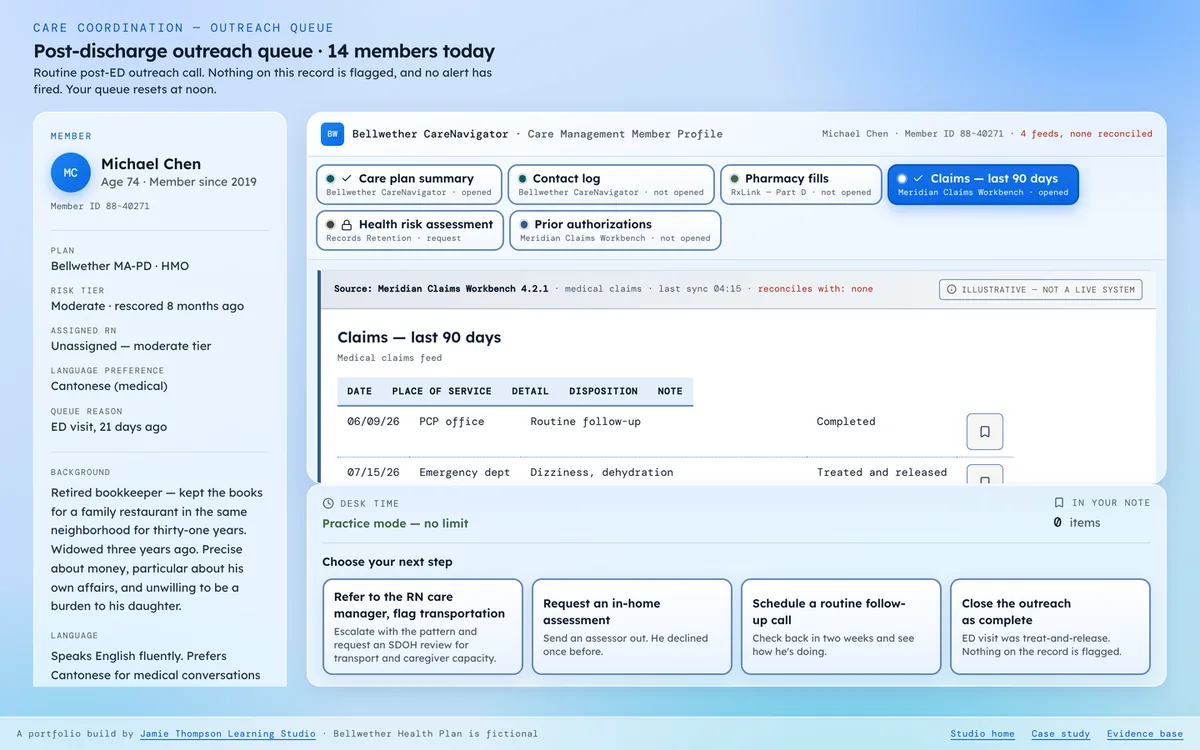
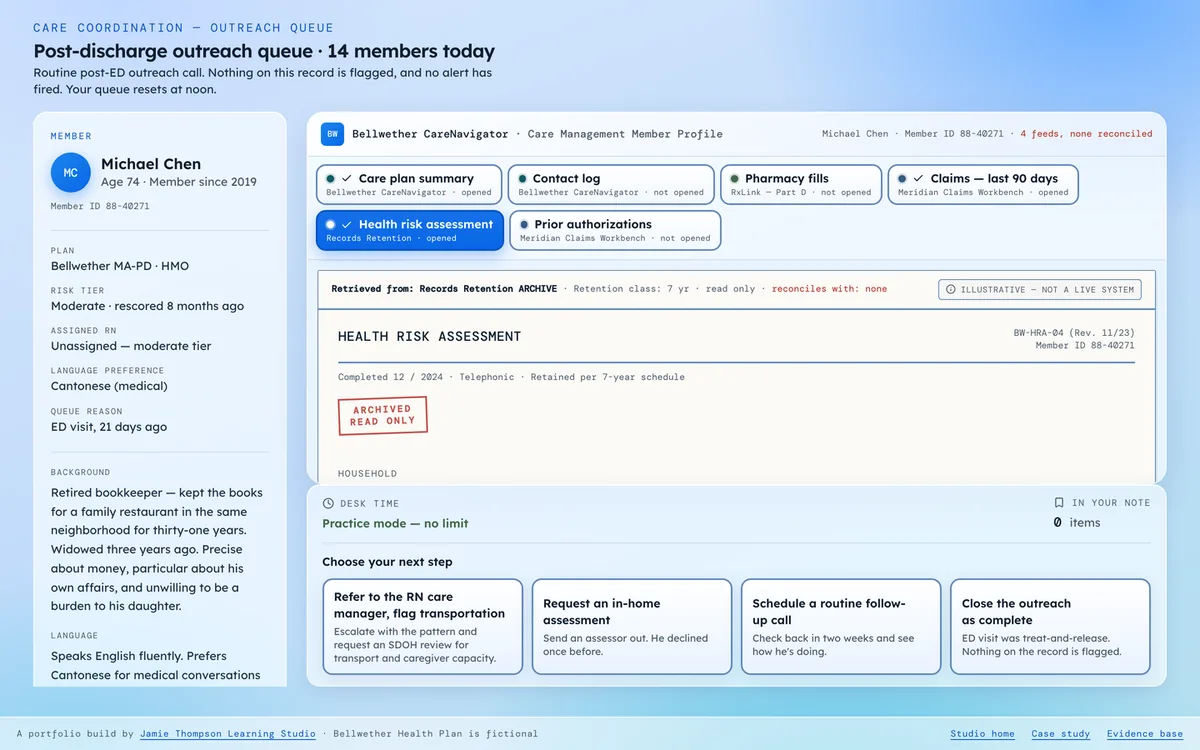
Decision Lab puts a learner at a desk with six records inside one care management member profile: a care plan, a contact log, read-only claims and pharmacy feeds, a prior-auth history, and one assessment that has to be retrieved from an archive. They flag what reads as a signal, spend a real time budget opening records to find out, and commit to one of four next steps. Then they do it again with a second member whose file looks almost identical and resolves the opposite way.
02 · The Move
Two cases, and why that was harder than it sounds.
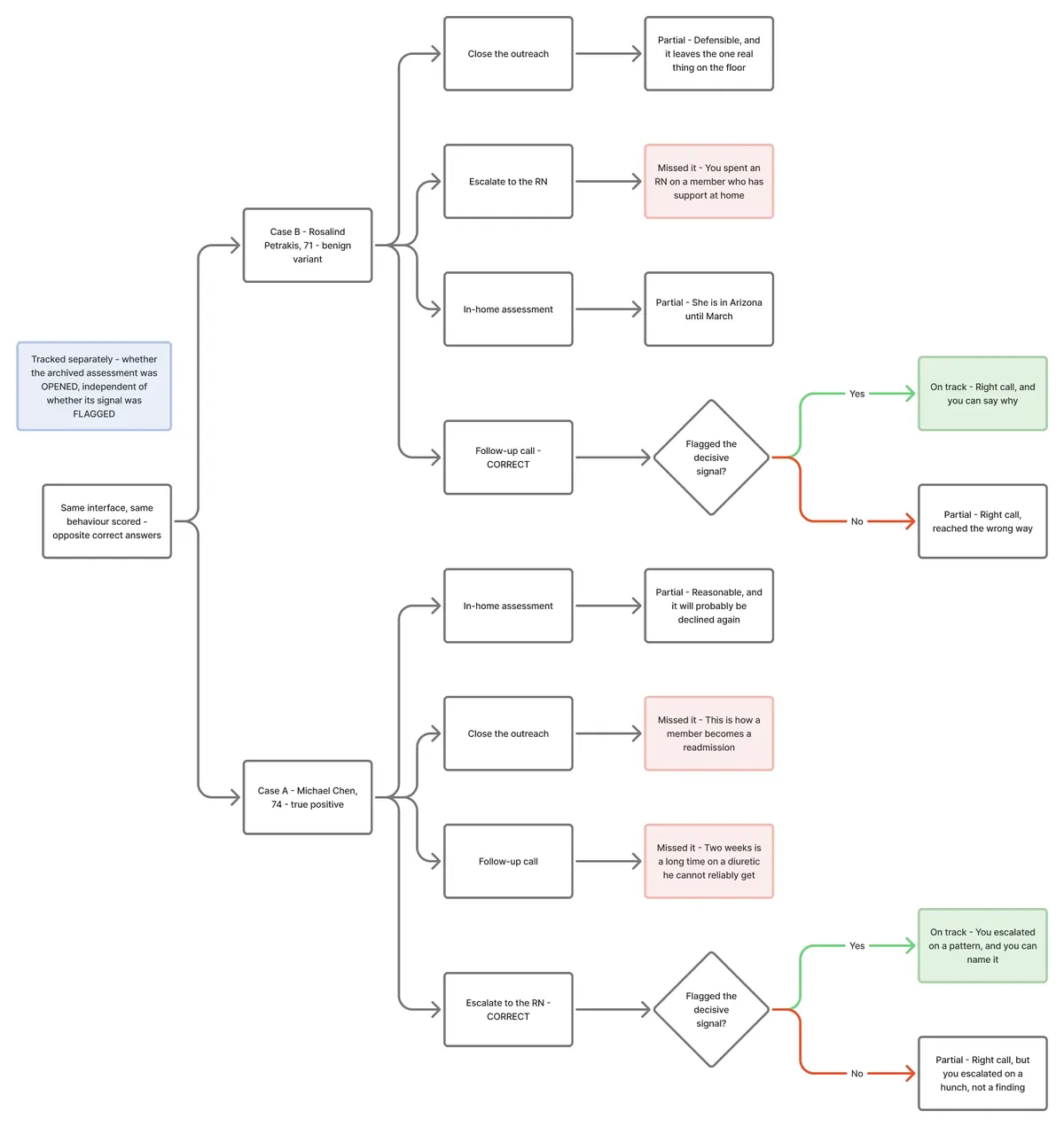
The first build had a real bug, caught in testing: the second case was a patch on the first — five fields overridden, everything else inherited. That included the signal map and the feedback tree, so the second case was being scored against the first case's answer key. A learner who got case two right was told they'd gotten it wrong, while the system quietly recorded a success.
Before
Case B was five overridden fields on top of Case A. Everything not overridden — including the signal map and the whole feedback tree — was inherited.
After
Two fully independent case files, same shape, sharing nothing but a schema. Records, signals, decisions, feedback and debrief are stated separately for each member — deliberately duplicated, not inherited.
The fix wasn't a patch on the patch. It was structural, because inheritance is what let the bug happen twice. If the two cases could contaminate each other's scoring, the claim that this measures discrimination rather than suspicion wouldn't be true. Adding a third case now means adding a file, not touching the engine.
03 · What It Asks of a Learner
Four feeds, one screen, a budget that never shows its hand.
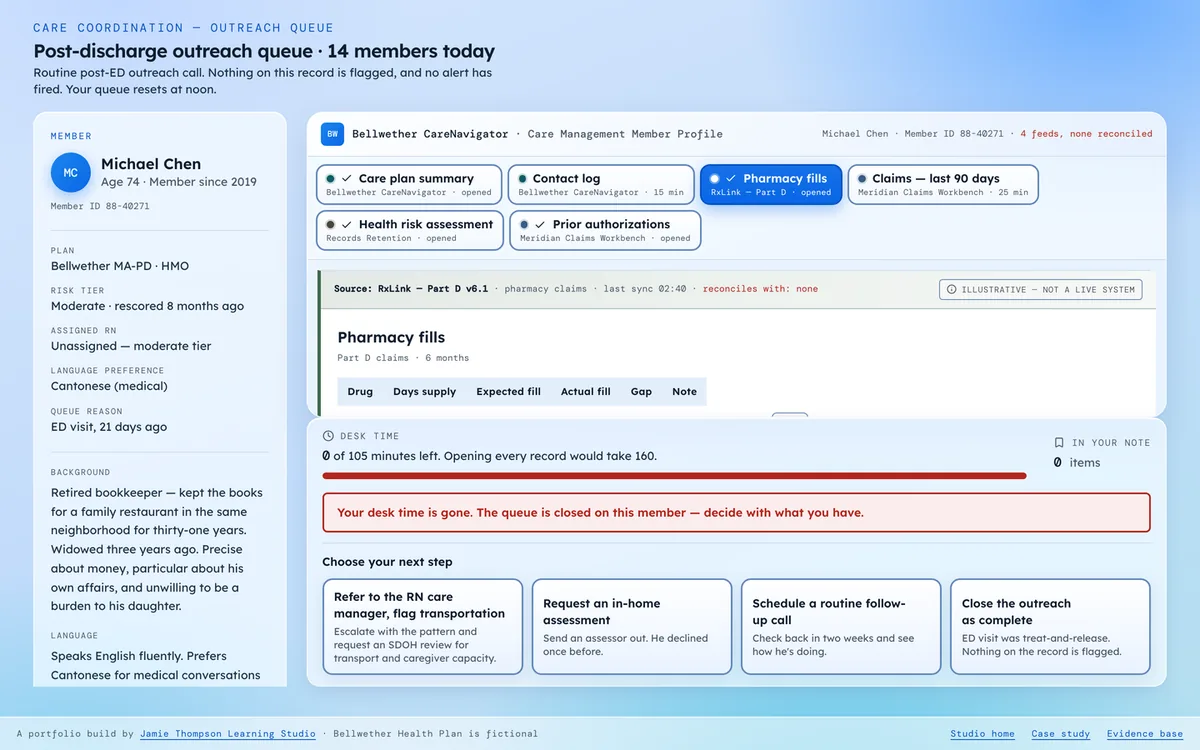
All six records live on one screen, inside the care management profile a non-clinical coordinator actually works in. Claims and pharmacy data arrive there as read-only feeds on their own overnight schedules, each stamped with where it came from, when it last synced, and what it reconciles against: nothing.
The panels look different because a claims extract doesn't look like a care plan note, even inside one product. But nobody had to go anywhere to see all of it. It was already in front of them.
5 signals each
Both members surface the same number of concerning items — and the right answer is opposite
1 record decides it
The deepest and most expensive to open, and the only place the answer is written down
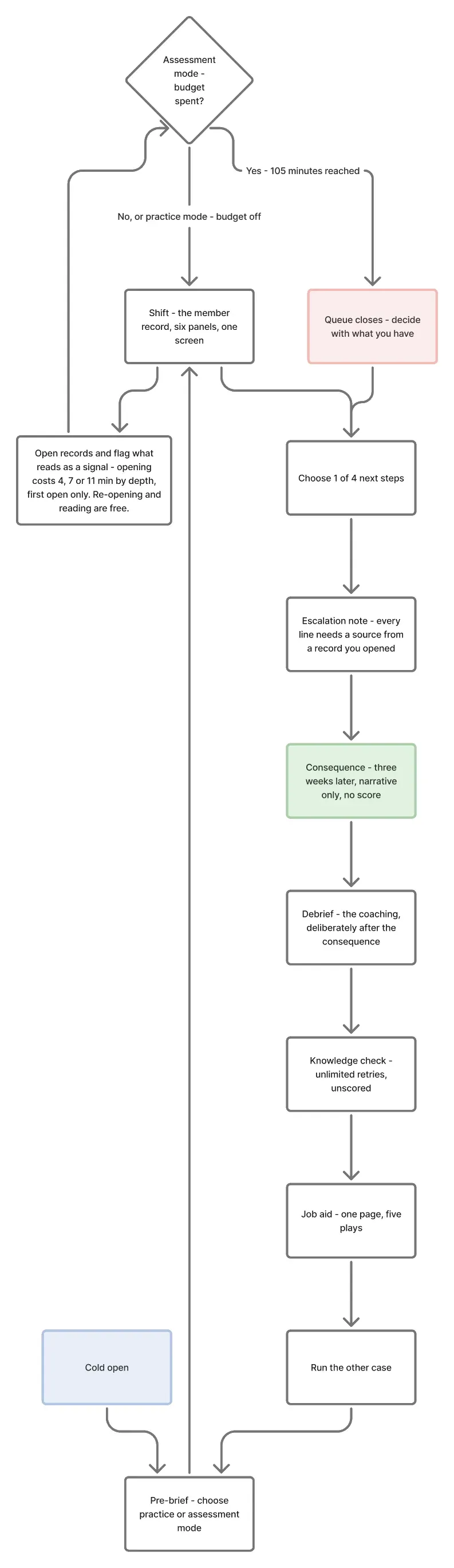
Opening a record for the first time costs minutes from a 105-minute shift budget, scaled to depth — and that cost is never shown as a hint. Anything can be flagged, whether or not it turns out to be a signal; a false flag counts against the read, not just a missed one.
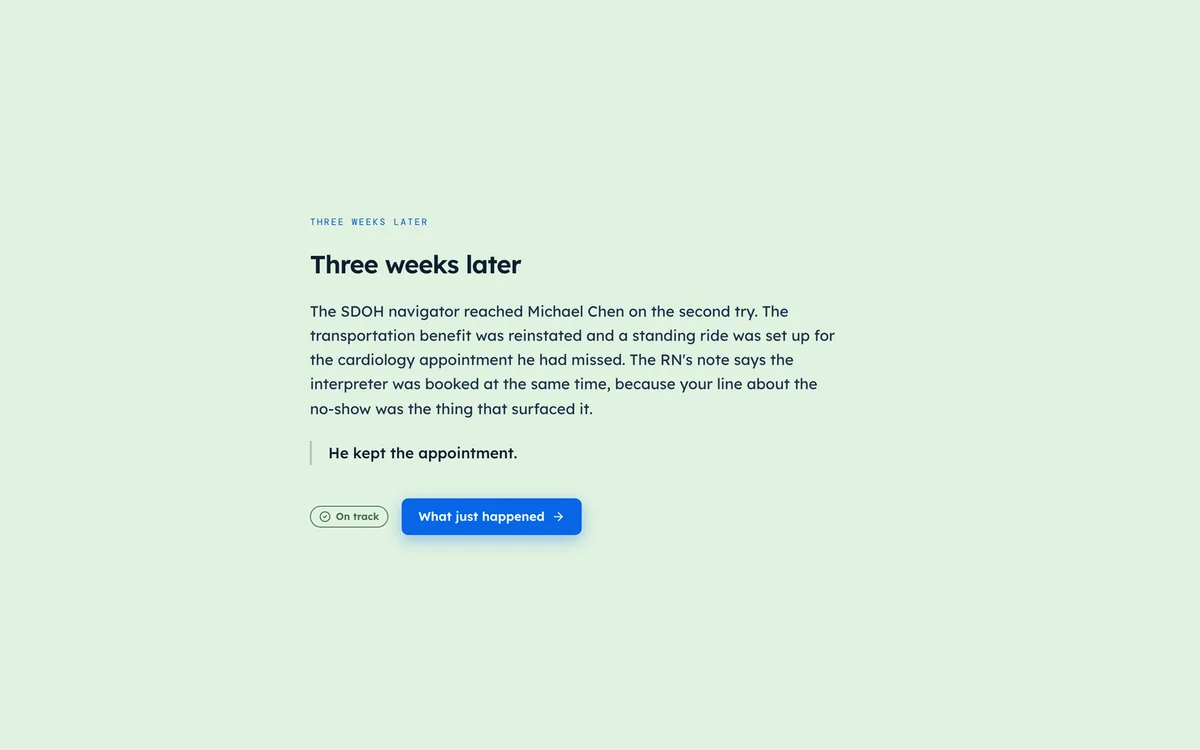
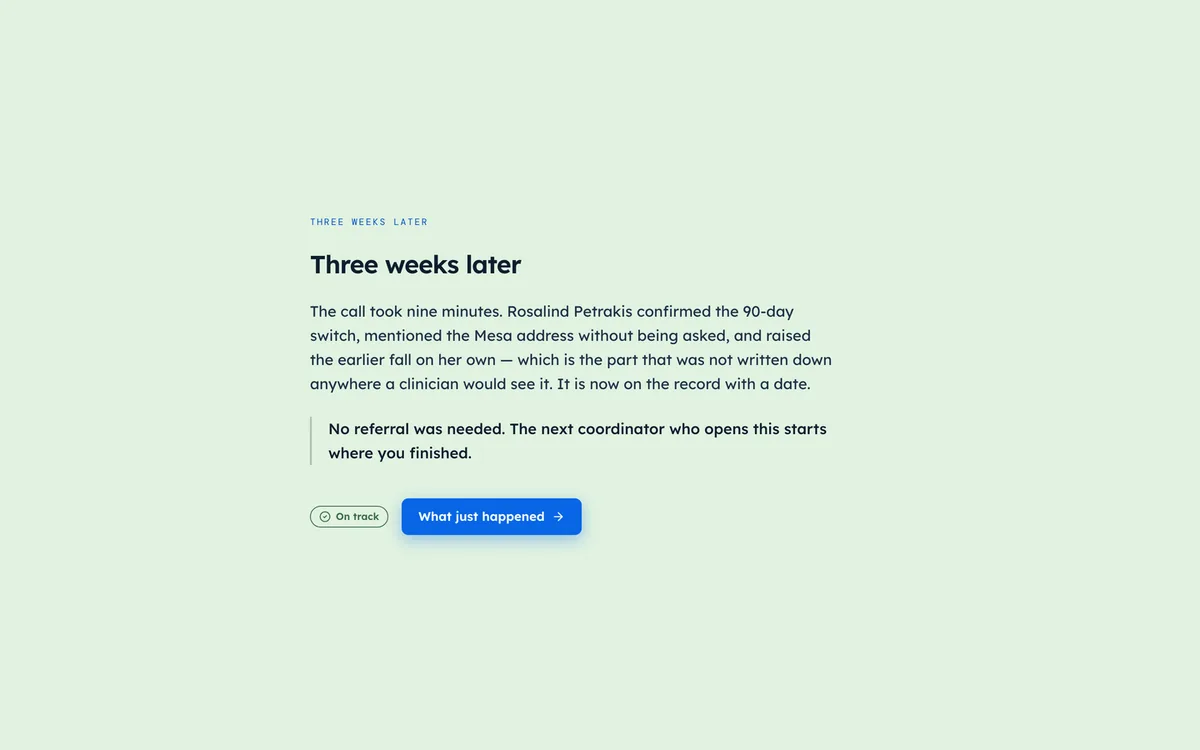
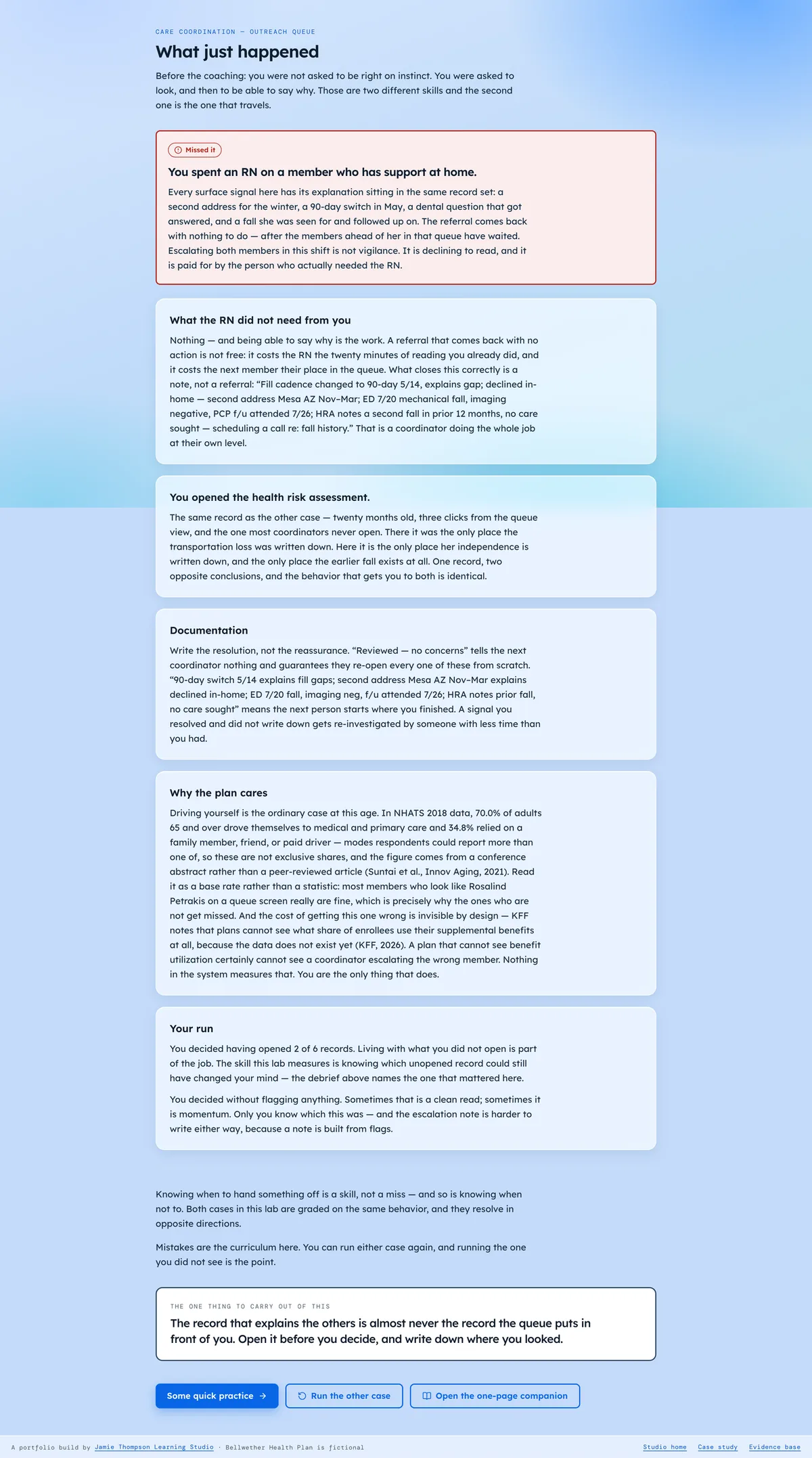
Then the learner commits, and the system tells them what happened — including a "three weeks later" consequence beat that plays out narratively, before any coaching voice. A consequence folded into feedback reads as a grade. A consequence that arrives as a story reads as what it actually is.
04 · How It's Built
Accessibility is a gate here, not a polish pass.
The design brief names specific failure modes rather than a generic "make it accessible": a tab pattern that declares ARIA roles but binds only to a mouse click is worse than not declaring the pattern at all. A countdown that updates without an announcement leaves a screen-reader user guessing. A time budget not explicitly labeled as a resource — not a wall clock — invites a WCAG objection on its own.
None of these are hypothetical. They are documented defects from an earlier pass at this build, kept in the project notes on purpose so they don't ship a second time. The record tabs now carry a full roving-tabindex pattern with arrow keys; the budget announces through a dedicated live region; and every color pairing in the build was checked by script rather than by eye.
Every cited fact in the evidence base was opened and individually verified before use, after an earlier draft's citations didn't hold up under checking. The evidence base ships with its discard ledger next to the surviving sources, not hidden.
Each tool did one job.
Each stage handed the next a written brief instead of a conversation — which is why a defect like the shared answer key gets caught before it reaches the next stage instead of after.
05 · How It's Measured
Measured, not marked complete.
A completion flag would say a learner reached the end. It would say nothing about whether they opened the record that mattered, or flagged noise as signal. So the build reports the decision itself.
Every run emits xAPI statements to a learning record store, in the order the work happens: initialized, inspected for each record opened, noticed for each flag raised, decided, terminated. The decision statement carries the instrument — how much of the evidence was opened, how many flags matched a real signal, how many did not, and whether the one record that would have changed the answer was ever read.
5
verbs per run — initialized, inspected, noticed, decided, terminated
7
result measures on every decision, including evidence completeness and flag precision
What one decision looks like in the store.
"actor": { "objectType": "Agent",
  "account": { "homePage": "https://jtlearningstudio.com/decision-lab/",
               "name": "1b397706-1941-496c-99cd-75fbf6e3f48c" } }
"verb":   { "id": ".../verbs/decided" }
"object": { "id": ".../activities/decision-point/next-step" }
"result": { "success": true, "response": "followup",
  "extensions": {
    ".../decision-class":          "followup",
    ".../time-to-decision-ms":     3012,
    ".../evidence-completeness":   0.667,
    ".../false-positives":         2,
    ".../flag-precision":          0,
    ".../opened-decisive-record":  true,
    ".../minutes-spent":           22 } }
A real statement from the store, abbreviated. A correct next step on the benign case, reached with two flags that were not signals — a right answer on imprecise evidence, which is the distinction a completion flag cannot make.
The store never receives a name.
Statements leave the browser for a same-origin proxy that holds the credential; the client carries no key. The proxy replaces the learner's identity with a pseudonymous account before forwarding, so the store holds decisions, not people — the account.name above is an identifier, not a person.
One rule is asserted on every build rather than trusted: what the screen says and what the statement records must agree. If feedback fires a miss, the statement cannot report success. An earlier version scored one case against the other's answer key, and the telemetry recorded success while the learner was told they were wrong.
Twelve demonstration runs, labeled as such.
To exercise the reporting end to end, twelve runs were driven through the live build — six per case, all four decisions, one to five records opened, none to eight flags. Every statement is tagged as demonstration data in the store. They show that the pipeline works and what a report looks like. They are not learner outcomes, and nothing here treats them as one.
06 · Where It Stands
What's verified, and what isn't yet.
Said plainly, because a portfolio piece that only shows the finished parts isn't a credible one.
- 01
The scoring bug is fixed and verified directly against both case files — each carries its own complete signal map, feedback and debrief, asserted on every build.
- 02
The build reproduces from source, so what ships matches what is on disk, and the screenshots on this page are scripted captures of the real build rather than hand-shot stills.
- 03
Contrast is checked by script, not by eye. A structural border token was failing the non-text contrast requirement at 2.01:1; it was found by computing every token against every surface it sits on, and the check now runs on every build so it cannot regress.
- 04
The record-access model was confirmed by a health-plan SME — what a non-clinical coordinator can see, and where the boundary sits between reading a determination and disputing one.
- 05
Telemetry is verified end to end — statements leave the live build, pass the proxy, and land in the record store with the full result payload; the count in the store rose by exactly the number sent.
- 06
Not yet done: a screen-reader pass. The keyboard path has been walked and the ARIA is right on inspection, but no screen-reader user has tested it, and inspection is not the same evidence.
- 07
Not yet done: usability testing. No learner outside the studio has run this end to end. Any claim about what it teaches is a design argument, not a finding.
- 08
A cohort label now reaches the store. The proxy passes only what its manifest allows, and a cohort was not on that list — so for a day, reports could not filter by cohort. The manifest is regenerated from the emitter, and the proxy now keeps one validated cohort grouping beside the fixed program grouping. Verified by sending one labeled statement and finding the cohort in the store's grouping chart. Runs made before the change carry no label; that is left as it is rather than back-filled.
Have a decision your people make on incomplete records?
That is the shape of most high-stakes work — a screen that looks routine, and a call that has to be made anyway. If you want practice that measures the decision instead of the click, this is what it looks like built.
Read the rest, or run it yourself.
The build takes about fifteen minutes to walk end to end, both cases.